Cellier Clinic — Personalized Anti-Aging & Lifting Specialist Design Clinic in Gangnam, Seoul

Medical Guide
Skin Laxity After Weight Loss: Non-Surgical Treatment
Non-surgical body contouring can improve firmness and skin quality after weight loss, but it cannot remove loose skin. Here is where the honest limit sits.
Schedule a ConsultationSkin Laxity After Weight Loss: Can Non-Surgical Body Contouring Help?
Medically reviewed by Dr. Youm Junghyun, Specialist in General Surgery, Director of Cellier Clinic
Non-surgical treatment can improve the firmness, texture, and tone of skin laxity after weight loss, and it can make a softened contour read as tighter. What it cannot do is take skin away. If a fold of skin hangs when you stand upright and stays there when you lift it and let go, the change you are picturing is a change in the amount of skin, and only surgery removes tissue. Understanding which of those two situations you are in is the single most useful thing you can do before booking anything.
What loose skin after a large weight change actually is
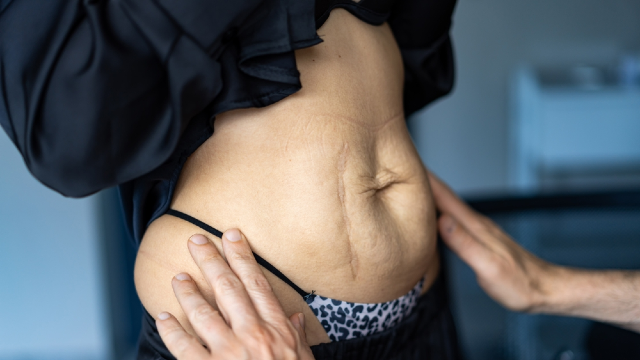
Loose skin is a change in the structure of the skin itself, not simply an empty space where fat used to be. Your skin is held taut by a network of collagen and elastin fibers in the dermis, the layer beneath the visible surface. When the body expands over a long period, that network stretches and remodels to cover a larger area. When the volume underneath is then reduced, the network does not automatically contract back to its original dimensions, and the surface it once covered is now larger than the body it sits on.
How much of it recoils depends on factors you do not control. The US National Library of Medicine's MedlinePlus service explains that skin loses elasticity with age, that the layer under the skin thins, and that the connective tissue supporting the skin changes over time — which is why the same amount of weight change produces very different skin outcomes at twenty-five and at fifty-five. How long the skin was stretched matters as well, as does whether the stretching left permanent marks in the dermis.
Those marks matter for expectations. Stretch marks are scars that formed in the dermis while the skin was under tension, and the American Academy of Dermatology treats them within its material on scars and stretch marks rather than as ordinary skin texture. A scar can be made less noticeable. It is not made to disappear, and a treatment plan that promises otherwise is not describing biology.
What a non-surgical energy treatment can and cannot change
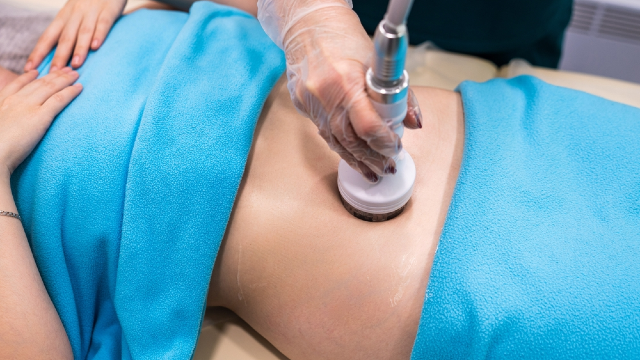
Energy-based body treatments work by delivering controlled heat into the skin and the tissue below it, prompting the body to build and reorganize collagen over the following weeks. The visible result of that process is a firmer, denser, better-quality surface. It is a change in the material, not a change in its area.
The Academy of Dermatology is direct about the ceiling here. In its guidance on firming sagging skin, it explains that non-invasive tightening produces gradual and generally subtle change, that results build over months rather than appearing at the end of an appointment, and that the treatments in this category suit mild to moderate looseness. For skin that has lost a large amount of its support, the Academy points readers toward a surgical consultation, because removing skin requires removing skin.
This is not a knock on the devices. A modest, honest goal is still a worthwhile goal, and many people who have lost a significant amount of weight have a mix of findings: some areas where the skin has genuinely lost quality and would respond to firming, some areas of residual localized fat, and sometimes one or two areas where the skin is simply in excess. The first two are within reach of non-surgical care. The third is not, and a good consultation says so out loud.
Where the honest limit sits
There is a rough test you can apply to yourself before you talk to anyone. If the skin looks softer and less firm than it used to but lies flat against the body when you stand, you are in the territory where firming treatments make sense. If the skin gathers into a fold or an apron that hangs under its own weight, drapes over a waistband, or stays creased after you release it, you are looking at an amount of skin, and no amount of heating will shorten it.
Past that limit, the correct route is a consultation with a surgeon about a body-contouring procedure that excises tissue. MedlinePlus describes reconstructive and cosmetic surgery as procedures that change the appearance or reshape the body, notes that they are still surgery with real risks, and advises people to understand what is involved before agreeing to anything. That is the conversation to have — not a compromise, just the right specialty for the problem.
There is also a middle position that deserves naming, because a lot of people occupy it. Some people with substantial loose skin do not want an operation, are not ready for one, or are not medically suited to one. Non-surgical care can still be worth doing for them, provided the goal is reframed honestly: better skin quality, better firmness in the areas where the skin has not fully given way, and improvement in the surface rather than restoration of the outline.
What Cellier Clinic documents in its body category
Cellier Clinic's Non-Surgical Body Contouring category holds five services — Abdominal Care, Body ONDA, Body Botox, Fat-Dissolving Injection, and Décolleté and Neck Care — aimed between them at localized fat, muscle-related bulk, cellulite, firmness, elasticity, and contour refinement without an incision. The clinic states plainly that results across this category should be understood as contouring and tissue-quality improvement rather than a substitute for substantial weight loss — which is exactly the framing this article has been building toward.
For someone whose main complaint is skin quality after a weight change, the service that speaks most directly to it is Abdominal Care. The clinic's premise for that program is that an abdomen presenting this way involves several findings at once — elasticity that has been lost, damage within the dermis, fluid retention, and circulation that has slowed — and that it should be evaluated as one structure extending from the surface down toward the fascia. The program can combine radiofrequency, ultrasound, and micro-regenerative injections along with circulation activation and swelling care, and the clinic lists improved abdominal firmness, stretch-mark improvement, fine-wrinkle improvement, and improved skin condition as its principal outcomes.
Its candidate list is written for exactly this reader: people wanting to manage a sagging abdominal line after childbirth, people concerned about reduced abdominal firmness, people concerned about stubborn abdominal tissue, people wanting to improve stretch marks or fine wrinkles, and people wanting a firmer, more refined abdominal contour. Cellier lists topical cream anesthesia and local injection anesthesia as applicable options depending on which components are selected, gives a session length of roughly twenty to thirty minutes, and puts downtime at approximately three days with temporary swelling or bruising possible. Cleansing and makeup may resume from the following day, and the clinic asks patients to avoid sauna, alcohol, and strenuous exercise for one week.
The other services in the category answer different questions. Body ONDA applies microwave energy with cooling to a selected area and is the clinic's option where localized fat and contour are the concern, which is covered in its own comparison article. Body Botox is a muscle treatment, planned around body proportions, muscle tension, and movement patterns, and is not a skin-laxity treatment at all. Fat-Dissolving Injection at this clinic is described for facial contour concerns such as excess cheek volume and a double chin. Knowing which of these maps onto your complaint saves a lot of time.
Timing: when in a weight-change journey to raise this
Skin assessment is most useful once the underlying volume has settled, because the tissue is still adapting while the number is still moving. If your weight is changing month to month, a firming plan built on today's contour is built on a moving target, and it is reasonable to say so in the consultation and ask how the clinician would sequence care.
Postpartum patients have an additional timing question, and Cellier answers it in the safest possible way: for postpartum patients, the appropriate interval after delivery or surgery should be determined by the treating physician. That is not a formality. The abdominal wall, the skin, and any surgical healing are all on their own schedules, and the person who managed your delivery is the one positioned to say when elective treatment is reasonable.
It is also worth being realistic about the calendar. Cellier's abdominal program is described as a course of three or more sessions spaced three to four weeks apart, so one visit to Seoul starts a plan rather than finishing one. If your trip is short, say the dates out loud at the consultation so the plan is built around the time you actually have rather than the time an ideal protocol would like.
Who should postpone or reconsider
Cellier's stated considerations for its abdominal program are pregnancy, an active skin infection or inflammation in the treatment area, unexplained abdominal pain or swelling, recent abdominal surgery before adequate healing, and medical conditions that make radiofrequency, ultrasound, or injectable procedures inappropriate. At the category level, the clinic notes that certain medical conditions, relevant implants, active skin conditions, or other factors may mean a particular treatment should be avoided or postponed, and that suitability is settled through individual medical assessment.
Two of those deserve emphasis for this reader. Unexplained abdominal pain or swelling is a reason to see a doctor about the symptom, not a reason to book an aesthetic appointment. And recent abdominal surgery — including a cesarean delivery or a bariatric procedure — needs to have healed before energy or injections are applied over it.
Preparation follows the same logic. The clinic asks patients to arrive with clean skin, to disclose medications, supplements, and prior aesthetic procedures, and to avoid alcohol and blood-thinning medication for twenty-four to forty-eight hours beforehand if advised. Disclose, but never stop a prescribed medication on your own — that decision belongs to the doctor who prescribed it.
Taking this into a consultation
Bring the history, not just the complaint. How much weight changed, over what period, how long ago it stabilized, whether there was a pregnancy or an operation involved, and what the skin looked like before. That history is what lets a clinician separate lost skin quality from excess skin area, and those two findings lead to different places.
The Academy of Dermatology publishes a list of questions worth asking before any cosmetic treatment, including who will perform it, what results are realistic for your particular situation, and what the recovery involves. MedlinePlus adds a simpler discipline that works well here: write your questions down before the appointment and ask the clinician to repeat anything you did not follow. A consultation in which the answer to "can this remove my loose skin" is no is a consultation that did its job. Cellier's before and after gallery is useful for the same reason, because it shows degrees of change rather than transformations.
The Bottom Line
- Loose skin after a large weight change is a structural change in the dermis, and the amount of skin covering your body does not shrink back on its own — how much recoils depends on age, duration, and individual tissue.
- Energy-based treatment improves the quality and firmness of skin; it does not reduce the area of skin. The Academy of Dermatology describes non-invasive firming as gradual and subtle, and appropriate for mild to moderate looseness.
- A fold that hangs under its own weight is a surgical question, and the honest answer is a referral rather than a longer course of device sessions.
- Cellier Clinic's Abdominal Care program is aimed at reduced firmness, stretch marks, fine wrinkles, swelling, and circulation, with about three days of downtime and a course of three or more sessions at three to four week intervals.
- Timing matters: assessment is most useful once weight has settled, and for postpartum patients the appropriate interval after delivery or surgery is set by the treating physician.
Frequently Asked Questions
Can a non-surgical treatment tighten loose skin on my stomach after weight loss?
It can improve firmness, texture, stretch marks, and overall skin condition, which is what Cellier Clinic lists as the principal outcomes of its Abdominal Care program. What it cannot do is reduce the amount of skin present. If your skin lies flat but feels soft and lax, that is the range where firming helps; if it gathers into a hanging fold, the change you want is surgical.
How do I tell whether I need surgery instead?
Stand upright in front of a mirror without holding anything in. If the skin stays against the body and the concern is that it looks softer and less taut, non-surgical firming is a reasonable conversation. If skin drapes, folds over itself, or stays creased after you release it, ask for a surgical opinion. MedlinePlus describes cosmetic and reconstructive surgery as procedures that reshape the body, and that is the correct specialty for excess tissue.
Will treatment help my stretch marks?
Stretch marks can be improved in appearance. Cellier lists stretch-mark improvement among the outcomes of its Abdominal Care program, alongside improved firmness and fine-wrinkle improvement. The Academy of Dermatology groups stretch marks with scars, and the realistic goal for any scar is that it becomes less noticeable rather than absent.
Should I wait until my weight has stabilized?
It is generally more useful to assess skin once the underlying volume has settled, because tissue continues to adapt while weight is still changing. Raise your current situation directly in the consultation, including whether you are still losing, and ask how the clinician would sequence treatment around it. That question is easier to answer before a plan is built than after.
I had a baby — how long should I wait?
Cellier states that for postpartum patients the appropriate timing after delivery or surgery should be determined by the treating physician. The clinic designed its abdominal program particularly with postpartum changes in mind, including a sagging abdominal line after childbirth, but the timing decision sits with the doctor who managed your care. Ask them first, then book.
What does the abdominal assessment actually look at?
Cellier assesses the abdominal skin and contour, identifies elasticity, stretch marks, fine wrinkles, swelling, and circulation concerns, then selects the appropriate radiofrequency, ultrasound, or micro-regenerative components, treats the area, incorporates circulation and swelling care, and provides post-treatment guidance. The clinic frames the abdomen as an integrated structure from the skin toward the fascia rather than as a fat problem alone.
Can I fit a full course into one trip to Korea?
Cellier describes the expected course as three or more sessions at three to four week intervals, which spans roughly two months. Most visitors complete one session on a single trip and plan the rest around a return visit or an extended stay. Discuss your travel dates at the outset so the sequence is designed around them.
This article is for general informational purposes and does not constitute individualized medical advice. Candidacy, technique, and expected outcomes can only be determined through a consultation with a qualified physician, and this article is not a self-diagnosis tool.
More Articles
Continue reading clinical insights and anti-aging guides from Cellier Clinic.
Can I Combine Botox, Filler and Skin Boosters in One Visit?
Combining Botox, filler and skin boosters in one visit to Korea is possible and planned together at Cellier Clinic. Here is what the appointment involves.
Learn More
Botox vs Dermal Filler: The Real Difference Explained
The difference between Botox and dermal filler is mechanism: one relaxes a muscle that creases skin, the other adds volume. Know which before your Seoul visit.
Learn More
Facial Contour Injection vs Dermal Filler: Jawline Guide
Facial contour injection reduces unwanted volume along the cheeks and jawline; dermal filler adds it. Compare candidacy, assessment, timelines and recovery.
Learn More