Cellier Clinic — Personalized Anti-Aging & Lifting Specialist Design Clinic in Gangnam, Seoul
Medical Guide
HIFU vs RF Skin Tightening: A Plain-English Comparison
HIFU vs RF skin tightening explained simply: focused ultrasound heats a chosen depth, radiofrequency warms a volume of tissue. Here is what that means for you.
Schedule a ConsultationHIFU vs RF Skin Tightening: A Plain-English Comparison
Medically reviewed by Dr. Youm Junghyun, Specialist in General Surgery, Director of Cellier Clinic
If you are researching HIFU vs RF skin tightening for the first time, the whole comparison rests on one idea: how each kind of energy travels through skin. Focused ultrasound concentrates its energy at a depth the clinician chooses, creating small separated points of heat below the surface while the layers above and below are left largely untouched. Radiofrequency behaves differently — it warms a broad volume of tissue at once, spreading heat through a layer rather than aiming at a single plane. Nearly everything else you will read about these treatments, from how they feel to how quickly you see a change, follows from that one structural difference.
What "Energy-Based Skin Tightening" Actually Means
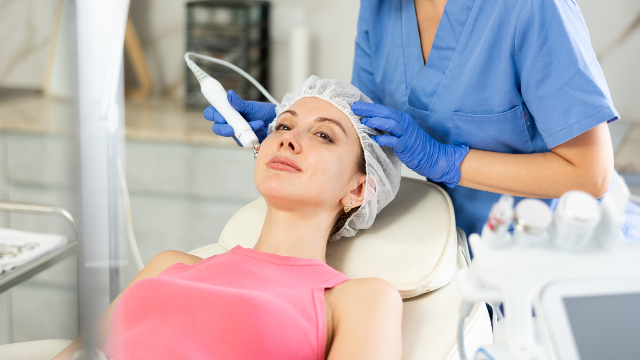
Energy-based tightening is a family of treatments that use controlled heat to prompt the skin to rebuild its own support structure, rather than cutting or removing anything. To understand why heat is the tool, it helps to know what changes with time. The US National Library of Medicine's MedlinePlus explains that as skin ages it loses elasticity, becomes thinner and more fragile, and the connective tissue underneath weakens — which is why a face that once looked taut begins to look softer along the jaw and cheek.
Collagen and elastin are the two proteins that give skin its firmness and its ability to snap back. An energy-based device delivers heat into a layer where those proteins live. The heat causes an immediate contraction of existing collagen fibers and, more importantly, triggers a repair response over the following weeks and months in which the body lays down new collagen. That is why the results of these treatments arrive slowly. You are not watching the device tighten your skin; you are watching your skin respond to the device.
The American Academy of Dermatology, in its patient guidance on firming sagging skin, describes ultrasound and radiofrequency as among the non-invasive options dermatologists use for mild to moderate laxity, and is candid that the change is gradual and subtler than surgery. That framing matters for a first-time medical tourist. These are refinement treatments. Cellier Clinic's own description of facial lifting and skin tightening follows the same logic: the clinic states that non-surgical treatments generally provide more gradual or modest lifting than surgical procedures, and that no treatment can permanently prevent natural aging.
How Focused Ultrasound Works: Energy Delivered to a Chosen Depth
Focused ultrasound tightens skin by concentrating sound energy into a small point at a predetermined depth. Ultrasound itself is not exotic — the FDA, in its consumer information on ultrasound imaging, explains that ultrasound uses sound waves at frequencies above the range of human hearing, which pass into the body and interact with tissue. The FDA also notes that ultrasound energy carries a potential to heat tissue, a property that diagnostic imaging keeps low and that aesthetic devices deliberately use.
The word "focused" is the operative one. Instead of spreading energy across a surface, the transducer converges it, the way a magnifying glass converges sunlight to a point. At the focal point, the temperature rises enough to create a tiny zone of thermal change; on either side of that point, the tissue is comparatively unaffected. A treatment is a grid of these points, delivered one "shot" at a time. This is what people mean when they call ultrasound tightening depth-targeted: the clinician is choosing a plane and treating it, not treating everything between the surface and that plane.
Cellier Clinic's portfolio shows how differently that principle can be applied. The clinic describes Ultherapy Prime as using High-Intensity Focused Ultrasound to target deeper structures — the fascia and dermis — and states that it uses DEEP SEE real-time ultrasound imaging together with three types of transducers, so energy can be placed at the intended depth for a given patient's skin thickness. Cellier states the treatment takes approximately 20 to 30 minutes for around 300 shots.
Sofwave, also in the ultrasound family, is described by Cellier as using centrally focused high-intensity ultrasound delivered through seven transducers to selectively stimulate the upper dermis, generating a cylindrical thermal column in the targeted layer while an automatic cooling system monitors skin temperature and keeps the outer surface cool. Cellier states this treatment takes approximately 15 to 20 minutes for 100 shots. Two devices, one physical principle, and two very different chosen depths — which is precisely the point. Depth is a decision, and with ultrasound it is made explicitly.
How Radiofrequency Works: Heat Spread Through a Volume
Radiofrequency tightens skin by passing an electrical current through tissue and letting the tissue's own resistance turn that current into heat. There is no focal point. The heat builds through a volume of tissue, warming a whole region of dermis toward a target temperature rather than creating separated thermal spots. If focused ultrasound is a series of precise pinpricks of heat, radiofrequency is a warm bath for a layer of skin.
Because RF depends on resistance, two things become important. The first is cooling: the outer skin has to be protected while the deeper tissue heats, so RF devices pair energy delivery with surface cooling. The second is calibration, since skin resistance is not the same from person to person or even from cheek to jawline.
Cellier's RF platforms illustrate both. The clinic describes Thermage FLX as a monopolar radiofrequency treatment that delivers heat into deeper skin layers, and sets out its treatment cycle plainly: the cooling system activates and automatic tuning begins, thermal energy penetrates while vibration continues, energy delivery continues with cooling maintained, and cooling runs again to protect the skin. Cellier states the session takes approximately 20 to 30 minutes for 300 shots, and that automatic tuning together with the cooling system helps deliver RF energy while protecting the skin.
Density Lifting, the clinic's other RF platform, is described as using two types of high-frequency energy — monopolar and bipolar — with a five-step cooling-gas injection method to protect the outer skin. Cellier explains that the system measures skin resistance and automatically corrects the energy so that what is delivered more closely matches the intended level, an approach the clinic calls impedance feedback. In plain terms: because resistance varies, the machine checks and adjusts rather than assuming. Cellier states the treatment takes approximately 20 minutes for 300 shots and that no anesthesia is required.
Monopolar and bipolar are worth one sentence each. Monopolar RF sends current from the handpiece through the tissue toward a return electrode elsewhere on the body, which lets the energy reach deeper. Bipolar RF passes current between two closely spaced points on the handpiece, which keeps the effect shallower and more contained.
The Differences You Will Actually Notice in the Treatment Room
The practical gap between the two categories shows up most clearly in comfort and in preparation. Because focused ultrasound concentrates energy at a point, the sensation is a brief, deep pulse repeated across the treatment grid, and numbing is usually part of the plan. Cellier lists anesthetic cream, nerve block, and sedation as possible pain-control options for Ultherapy Prime, and describes the platform as having a reduced pain burden compared with previous models. For Sofwave the clinic lists anesthetic cream, and positions the treatment as a low-pain option for people who want ultrasound-based improvement with minimal irritation.
On the radiofrequency side, sensation tends to read as heat rather than as a pulse. Cellier lists topical cream, nerve block, and sedation as options for Thermage FLX, and states that some patients experience heat, tingling, or discomfort during RF treatment, with the level varying by individual sensitivity. For Density Lifting the clinic states that no anesthesia is applied.
Downtime, by contrast, is similar across both categories, and it is short. For every one of these four platforms, Cellier states that daily activities can be resumed immediately after treatment and that face washing and makeup can generally begin the next day. The aftercare instruction is also consistent: keep the area clean, apply sunscreen daily, and stay away from saunas, alcohol, and hard exercise for a week. Temporary redness, swelling, and a tingling sensation are the commonly listed side effects, and Cellier states these usually subside naturally.
What Results Look Like on a Calendar
Both categories produce gradual results, but the timelines are not identical, and knowing them prevents the most common disappointment. For Ultherapy Prime, Cellier states that changes may be felt at around four weeks, that peak collagen regeneration and optimal lifting are typically realized around two to three months after treatment, and that effects last approximately six to twelve months depending on individual skin condition. For Sofwave, the clinic states that effects begin to appear about one month after treatment and peak at approximately three months.
For Thermage FLX, Cellier indicates that changes may become noticeable at approximately four weeks, that collagen production continues to be activated after treatment, and that the effect generally lasts approximately six to twelve months. For Density Lifting, the clinic states that changes may be felt after approximately one week, with maximum effect after three to four weeks and a stated duration of approximately three to six months.
Read those numbers together and a useful pattern appears: none of these treatments finishes on the day it is performed, and all of them are maintenance treatments rather than permanent corrections. If you are planning a single trip to Seoul, the treatment you receive will still be developing after you land back home. The American Academy of Dermatology makes the same point in its guidance on firming sagging skin, noting that results from non-invasive tightening appear gradually as the body produces collagen.

How a First-Time Patient Should Think About the Category
Before comparing brand names, it is more useful to ask which layer of your face is the problem. That is the question the two categories answer differently. Cellier's candidacy descriptions make the distinction concrete without requiring you to memorize device specifications.
The clinic describes Ultherapy Prime as suited to people troubled by reduced elasticity, a double chin, unclear facial contours, lines near the eyes or in the glabella area, and weak lifting results linked to thick skin, as well as those seeking a strong, long-lasting lift. Sofwave, by contrast, is described as suited to adults with mild to moderate laxity, reduced elasticity, fine lines, or early sagging who want a low-pain treatment with minimal downtime — and Cellier specifically notes it may suit people with thin or sensitive skin concerned about irritation.
On the RF side, Cellier describes Thermage FLX as recommended for people in their thirties or older concerned about loss of elasticity, people with little cheek fat and thin faces, and those with thin skin concerned about irritation. Density Lifting is described as suitable for people concerned about reduced elasticity, fine or deep wrinkles, sagging contours, uneven texture, or areas with reduced volume.
You do not need to resolve this yourself. Cellier states that its consultation assesses skin laxity, facial contours, skin thickness, treatment areas, medical history, and treatment goals before a platform is selected, and that Dr. Youm Junghyun chooses among the clinic's lifting platforms based on individual skin thickness and treatment goals, using more than one in combination where indicated. The productive posture for a first consultation is to describe what bothers you and let the assessment map it to a layer. The clinic's introduction to its own care approach sets out how it frames that assessment.
Safety, Screening, and Who Should Wait
Both categories are non-invasive, and both still require screening — the contraindications differ in an instructive way. For ultrasound-based treatment, Cellier states that people who are pregnant or breastfeeding, who have active skin infections or significant inflammation in the treatment area, or who have certain medical conditions that make ultrasound treatment unsuitable should be evaluated before proceeding.
For radiofrequency, an additional item appears: implanted electronic devices. Cellier states that RF treatment may need to be delayed or ruled out for people who have certain implanted electronic devices, an active skin infection or marked inflammation where treatment would be applied, or other conditions that make RF inappropriate. This is a direct consequence of the mechanism — RF passes current through tissue, so anything electronic in the body is a screening question. The clinic also states that pregnant patients should receive individual medical assessment because the safety of elective RF treatment during pregnancy has not been established.
Patient safety guidance published by the American Academy of Dermatology emphasizes that who performs a procedure and what training they have are central to the outcome, and that a qualified physician should evaluate whether a treatment is appropriate for you before it is performed. Cellier's stated risk-reduction measures follow that logic device by device: real-time visualization of skin layers and transducer selection for ultrasound, and automatic tuning, impedance feedback, and cooling systems for radiofrequency.
Regulation is worth understanding before you travel, because the terms are easy to misread. The FDA groups devices intended to improve appearance under aesthetic devices, and separately explains that "FDA registered," "FDA cleared," and "FDA approved" are not interchangeable — registration of a facility is not the same as a review of a device, and clearance and approval follow different pathways. Just as importantly, US regulatory status governs marketing in the United States. Korea runs its own certification system, and the two are separate. Cellier Clinic is a Registered Medical Institution for Attracting Foreign Patients, certified by the Ministry of Health and Welfare — a Korean designation for clinics treating international patients, not a US one.
Planning the Trip Around the Treatment
For a short trip, the scheduling question is easier than most people expect, because these treatments do not require surgical recovery. Cellier states that one to two days in Korea is generally sufficient for Ultherapy Prime, Sofwave, and Thermage FLX, and that one day can generally be sufficient for Density Lifting. The clinic states there is no surgical restriction on flying afterward and that most patients fly the day after treatment.
The CDC's Yellow Book guidance on medical tourism advises travelers to plan care abroad in advance, understand what the procedure involves, and arrange follow-up before they leave home. That last point deserves emphasis here: because energy-based tightening develops over weeks, your results will mature after you return, and knowing how to reach the clinic with a question is part of the plan. Cellier states that English-speaking support is available for consultations, and lists its location as the fifth floor of Rex Tower, 108 Dosan-daero, Gangnam-gu, Seoul, accessible from Sinsa Station on Subway Line 3 or the Shinbundang Line.
MedlinePlus, in its guidance on talking with your doctor, suggests writing down your questions before an appointment so nothing is forgotten in the room — a small habit that works especially well when the consultation is happening in a second language. A ready-made starting point is the set of pre-treatment questions published by the American Academy of Dermatology: what results are realistic, what the recovery involves, what the risks are, and what happens if you are unhappy. Looking at documented before and after results can also help calibrate what a realistic change looks like before you commit. When you are ready to discuss your own case, you can contact Cellier Clinic to arrange a consultation.
The Bottom Line
- Focused ultrasound concentrates energy into separated points at a chosen depth, while radiofrequency warms a broad volume of tissue — that single difference explains most of what varies between the two categories.
- Cellier Clinic's portfolio shows both principles in use: Ultherapy Prime and Sofwave on the ultrasound side, Thermage FLX and Density Lifting on the radiofrequency side, each applying its principle at a different layer and intensity.
- Neither category delivers its result on treatment day. Cellier states changes are typically felt from about one to four weeks, with peak effect at roughly one to three months and duration measured in months, not years.
- Downtime across all four platforms is short — Cellier states daily activities resume immediately, with face washing and makeup from the next day, and saunas, alcohol, and strenuous exercise avoided for one week.
- Screening differs by mechanism: radiofrequency adds implanted electronic devices to the list of things to disclose, which is why your medical history matters before a platform is chosen.
Frequently Asked Questions
What does energy-based skin tightening actually treat?
It addresses mild to moderate skin laxity — the softening of the jawline, cheeks, and neck that comes with reduced elasticity. The American Academy of Dermatology describes ultrasound and radiofrequency as non-invasive options dermatologists use for this kind of change, with gradual results. Cellier Clinic describes its facial lifting and tightening treatments as suited to adults with mild to moderate laxity, reduced firmness, fine lines, or early sagging.
How long does a single session take?
Session length depends on the platform and the number of shots delivered. Cellier states that Ultherapy Prime and Thermage FLX each take approximately 20 to 30 minutes for around 300 shots, that Sofwave takes approximately 15 to 20 minutes for 100 shots, and that Density Lifting takes approximately 20 minutes for 300 shots. Numbing time, where used, is additional to the treatment itself.
How soon will I see a change?
Expect the change to develop over weeks. Cellier states that changes may be felt at around four weeks for Ultherapy Prime and Thermage FLX, that Sofwave results begin at about one month and peak at approximately three months, and that Density Lifting changes may be felt after about one week with maximum effect at three to four weeks. The gradual pace reflects the time your body needs to produce new collagen.
Does one category hurt more than the other?
Sensation differs by platform rather than strictly by category, and numbing is matched to the treatment. Cellier lists anesthetic cream, nerve block, and sedation as options for Ultherapy Prime and Thermage FLX, lists anesthetic cream for Sofwave, and states that no anesthesia is applied for Density Lifting. The clinic describes Sofwave as a low-pain option and states that Ultherapy Prime has a reduced pain burden compared with previous models.
How many days do I need in Seoul?
A short stay is generally enough because there is no surgical recovery. Cellier states that one to two days is generally sufficient for Ultherapy Prime, Sofwave, and Thermage FLX, and that one day can generally be sufficient for Density Lifting. The clinic states there is no surgical restriction on flying and that most patients fly the day after treatment.
Can more than one platform be used for the same patient?
Yes, when the assessment supports it. Cellier states that Dr. Youm Junghyun selects among the clinic's lifting platforms based on individual skin thickness and treatment goals, and uses more than one in combination where indicated. The decision is made during consultation, after skin laxity, facial contours, skin thickness, and treatment goals have been assessed.
What should I avoid after treatment?
Cellier's aftercare instruction is consistent across these platforms: cleanliness at the treated site, daily sunscreen, and a week without saunas, alcohol, or hard exercise. Face washing and makeup can generally begin the next day. Temporary redness, swelling, or tingling may occur and the clinic states these usually subside naturally.
Does US regulatory status apply to a device used in Korea?
US device regulation governs marketing in the United States. The FDA explains that "FDA registered," "FDA cleared," and "FDA approved" mean different things and are not interchangeable, and that registration of a facility is not a review of a device. Korea operates its own certification system separately; Cellier Clinic is a Registered Medical Institution for Attracting Foreign Patients, certified by the Ministry of Health and Welfare.
This article is for general informational purposes and does not constitute individualized medical advice. Candidacy, technique, and expected outcomes can only be determined through a consultation with a qualified physician, and this article is not a self-diagnosis tool.
More Articles
Continue reading clinical insights and anti-aging guides from Cellier Clinic.
Can I Combine Botox, Filler and Skin Boosters in One Visit?
Combining Botox, filler and skin boosters in one visit to Korea is possible and planned together at Cellier Clinic. Here is what the appointment involves.
Learn More
Botox vs Dermal Filler: The Real Difference Explained
The difference between Botox and dermal filler is mechanism: one relaxes a muscle that creases skin, the other adds volume. Know which before your Seoul visit.
Learn More
Facial Contour Injection vs Dermal Filler: Jawline Guide
Facial contour injection reduces unwanted volume along the cheeks and jawline; dermal filler adds it. Compare candidacy, assessment, timelines and recovery.
Learn More